
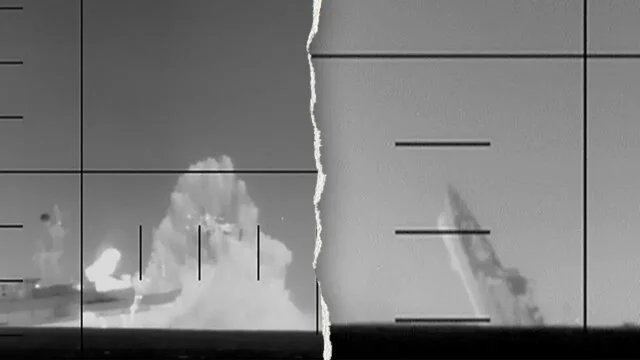
U.S. Army Secretary Peter Huggins stated in the latest update released by the Pentagon on Wednesday that a multi-million-dollar U.S. Navy torpedo detonated beneath an Iranian warship during a nighttime submarine attack off Sri Lanka's southern coast—marking the first such assault since World War II.
According to a former U.S. submarine commander, the weapon—identified as a Mark 48 Advanced Capability (ADCAP) torpedo—underscores the scale of force employed and sends a “no-gloves-off” signal to Tehran.
“The Mark 48 is one of the deadliest anti-ship weapons in the U.S. inventory,” Thomas Shugart, a senior fellow at the Center for a New American Security, told Fox News Digital.
Shugart said the torpedo carries a 650-pound warhead designed not to strike the vessel directly but to detonate beneath it, creating a massive vapor bubble that tears through the stern and splits the ship in two.
U.S. Army Secretary Peter Huggins confirmed Wednesday that a U.S. submarine sank an Iranian warship in international waters in the Indian Ocean. (@DeptofWar/X)
“The torpedo detonated beneath the stern of the Iranian vessel, lifting it out of the water and sinking it within minutes,” he stated.
Based on recent data, each torpedo costs approximately $4.2 million. Shugart compared this attack to one of the rarest submarine strikes in modern naval history.
Beyond World War II, he referenced the 1982 Falklands War, when a submarine-launched torpedo sank a major surface vessel.
“This is only the second time a nuclear-powered submarine has sunk a ship with a torpedo,” Shugart stated.
“The only other instance was when the British submarine HMS Conqueror sank the Argentine cruiser General Belgrano during the 1982 Falklands War,” he added.
Trump Claims U.S. Deployed to Iran “Ahead of Schedule,” Vows “Smooth Takeover” of Power
Tuesday, January 14, 2025: President Donald Trump nominated Peter Hagers as Secretary of Defense, who completed his confirmation hearing before the Senate Armed Services Committee at the U.S. Capitol in Washington.
He stated that naval submarine operations would include enhanced surveillance, additional naval deployments, and targeted actions aimed at demonstrating U.S. maritime dominance.
“This absolutely strikes me as a message that the gloves are truly off,” Shugart said.
“An American submarine sank an Iranian warship that believed itself to be safe in international waters,” Haggard told reporters at a Wednesday press conference.
Former Top Gun pilot declares Iranian forces “finished” under U.S. air superiority, but warns of another threat
In this U.S. Navy photo, the Los Angeles-class fast-attack submarine USS Oklahoma City (SSN 723) returns to the U.S. Naval Base Guam on August 19, 2021. (Mass Communication Specialist 3rd Class Naomi Johnson/U.S. Navy via AP)
Hershgeis described the attack as “a quiet kill,” noting it was the first instance since World War II where an enemy vessel was sunk by torpedoes.
“The U.S. Navy's submarines are highly maneuverable, exceptionally quiet, and our crews are highly trained,” Shugart stated. “Launching torpedoes poses no challenge for U.S. Navy submarines.”
He added, “For a U.S. nuclear-powered submarine, tracking down and sinking an Iranian vessel like this is not a challenging mission.”
The target vessel, identified as the “IRIS Dena,” was the newest frigate in the Iranian Navy fleet, equipped with surface-to-air missiles, anti-ship missiles, torpedo launchers, and other heavy weaponry.
According to Sri Lankan Foreign Minister Vijaya Khuratta, the country's coast guard received reports of an explosion on an Iranian vessel at 5:08 a.m. local time on Wednesday.
The former Central Command chief detailed the “excellent intelligence” behind the Iranian attack, stating the next focus is on “missile mathematics.”
On Wednesday, March 4, 2026, medical personnel unload the bodies of Iranian sailors who died when the IRIS Dena warship sank off the coast of Galle, Sri Lanka.
Shugart stated: “I'm not certain if Iran currently possesses any operational submarines, but if they were deployed, their largest vessels would be at least 20 or 30 years old.”
“These would be former Russian diesel-electric submarines, meaning they lack nuclear propulsion, satellite communications, and unlimited endurance—unlike American submarines.”

Comentarios 0
Deja un comentario