
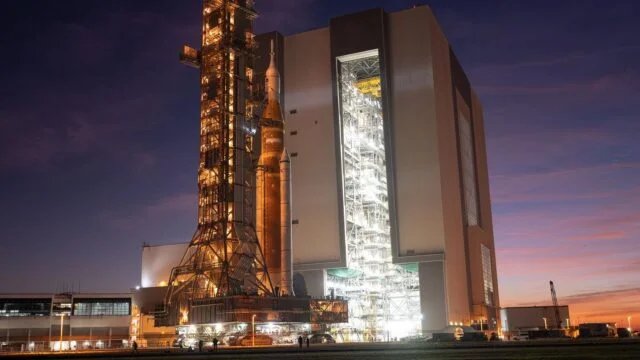
NASA has conducted a thorough overhaul of its Artemis 2 rocket, evidently preparing for the April launch of the first crewed lunar mission in over 50 years.
Engineers performed an adjustment aimed at restoring stable helium flow to the Artemis 2 upper stage of the Space Launch System (SLS) rocket, agency officials announced in a Tuesday update (March 3).
“Dedicated to the rocket,” NASA wrote in the update, the spacecraft will continue operations in the coming weeks as the agency prepares to return the rocket to the launch pad later this month for a potential April launch.
The maintenance work took place inside NASA's Vehicle Assembly Building (VAB) at Kennedy Space Center (KSC) in Florida.
The Artemis II SLS and Orion crew capsule have been in the VAB since returning to the hangar from Launch Pad 39B at KSC on February 25. Just days ago, the Artemis II crew successfully completed a two-day dress rehearsal, a pre-launch procedure.
However, following that test, NASA noted a helium flow interruption in the SLS upper stage. This is a critical issue because helium pressurizes the rocket's fuel tanks. Retrieval was the only option, as the affected area of the upper stage is inaccessible on the pad.
This problem delays Artemis 2's potential March launch, which would carry four astronauts on a roughly 10-day flight starting Monday. This would mark the first crewed flight near the Moon since Apollo 17 in 1972.
The latest space news, rocket launch updates, sky observation events, and more!
The next launch window for Artemis 2 opens in April, with potential launch dates on April 1, April 3-6, and April 30. These options remain viable following recent work at the VAB.
The focus of this work is the seal at the interface where helium flows from ground equipment to the SLS upper stage. This seal clogged the interface, known as a quick disconnect.
NASA officials wrote in Tuesday's update: “The team removed the quick disconnect, reassembled the system, and began verifying the upper stage repair by reducing helium flow through the mechanism to ensure the issue is resolved.” “Engineers are assessing why the seal detached to prevent recurrence.”
The Artemis 2 team is also utilizing VAB time in other ways. For instance, technicians are replacing flight batteries on the SLS core stage, upper stage, and solid rocket boosters, while charging the Orion's emergency shutdown batteries. NASA officials noted they are also “powering a new set of flight termination system batteries before conducting end-to-end retesting of the system.”
The latest Artemis 2 update follows a broader announcement that NASA is restructuring the Artemis program. For instance, Artemis 3 will no longer be the first crewed lunar landing mission; Instead, Artemis 4 is now scheduled for its first flight in 2028. Artemis 3 will remain in Earth orbit and conduct a rendezvous between the Orion spacecraft and one or two private lunar landers contracted by NASA for the Artemis program.

Comentarios 0
Deja un comentario